Italy’s Silent AI Boom: How Italian Companies Rewired Their Software Budgets in Q1 2026
AI is now the only software category that is actually growing on Italian corporate cards. More than 8 in 10 Italian companies are paying for at least one AI tool — and Claude’s spend just grew almost five times in a single quarter. Here’s what the data really says about AI adoption in Italy.
Something quiet but important is happening inside the software budgets of Italian companies. While most categories — advertising, travel, infrastructure, back-office SaaS — have been essentially flat for the past year, one line item keeps bending upward every single month: AI.
We analyzed one full quarter of anonymized card transactions from Italian companies using Withless. What we found is a clean, unambiguous trend that isn’t really reflected in public discourse yet: AI has quietly become the fastest-growing category in Italian software spend, and adoption is now mainstream rather than experimental.
In 90 days, AI went from roughly 1 in 22 euros of Italian software spend to about 1 in 13 — a 65% jump in share, while every other category stayed flat.
How big is AI spend inside Italian software budgets?
In January, AI represented about 4.6% of total software spend. By February it was nearly 6%. By March, it had climbed to 7.5%. Absolute AI spend grew by roughly +83% across the quarter, while overall software spend stayed essentially flat month over month.
Translated into the kind of chart a CFO would recognize: AI is the only category that is actually moving. Everything else is stable. If March’s slope continues, AI will cross 10% of total software spend before summer — the level at which a category stops being a side-bet and starts showing up in quarterly board decks.
Who is actually buying AI? (Spoiler: almost everyone)
The single most striking number in the dataset is the adoption rate. Among Italian companies with active software spend this quarter, 83% bought at least one AI tool. This is no longer an early-adopter pattern — it is the default corporate behavior.
A few textures behind that headline:
- The typical AI-adopting company runs 3 to 4 AI vendors in parallel. The median portfolio is exactly 3 tools; a long tail of companies runs 5 or more.
- At the median, AI is about 4% of a company’s total software spend. But roughly 1 in 8 adopters already sends more than 20% of their software budget to AI vendors — a credible leading indicator of where the rest of the market is heading.
- Adoption cuts across company size: the top AI spender in the dataset is a mid-sized operator, not a hyperscaler or enterprise.
The breakout story: Anthropic is catching up to OpenAI, fast
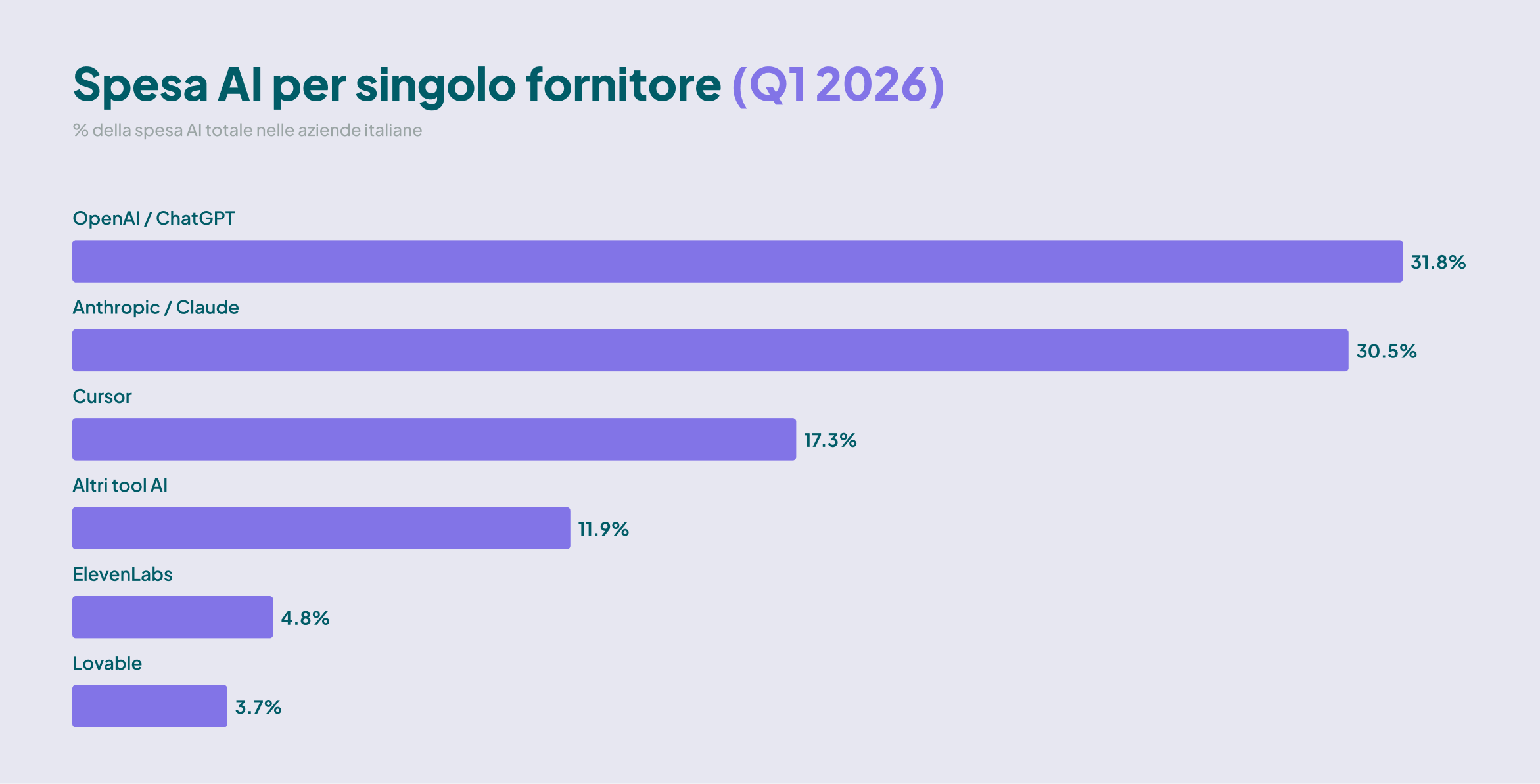
OpenAI is still, today, the single largest AI vendor by spend on Italian corporate cards — about 32% of all AI spend. But the momentum has clearly shifted. Over Q1 2026:
- OpenAI’s spend was essentially flat, slightly down (roughly −3% January to March).
- Anthropic’s spend grew by nearly 400% in the same 90 days — and it did so through a near-tripling in the number of transactions, not a single enterprise deal.
- By the end of the quarter, Anthropic had more paying Italian companies than OpenAI, and Claude accounted for roughly the same share of AI spend as ChatGPT (~30%).
On the current trajectory, Anthropic is on track to overtake OpenAI in absolute Italian B2B spend within the next quarter. That would have been an implausible claim six months ago.
This matters beyond vendor gossip. The Italian B2B market is in the middle of one of the fastest competitive re-rankings the SaaS industry has seen in years — and it is happening below the radar of most analyst coverage, because it is showing up as thousands of small card charges rather than a single headline contract.
“Vibe coding” becomes a budget line
After the big LLM providers, the fastest-growing category is AI-native developer tooling. Cursor is already the single largest AI coding tool in the dataset, present in a significant minority of all Italian companies we looked at. Lovable — the European “prompt-to-app” product that was essentially unknown 6 months ago — grew +156% in a quarter and is now in about 1 in 5 AI-adopting companies.
Put together, AI coding tools (Cursor, Lovable, Replit, v0, Bolt.new, Windsurf, Factory AI, and others) represent roughly 22% of the entire AI wallet — second only to the foundation model providers themselves. Unlike traditional IDE licenses, most of this is billed in small recurring increments on individual employees’ corporate cards. “Vibe coding” is no longer a meme; it’s a line item.
The usage curve, not the license curve
One pattern repeats everywhere in the data: AI is being billed as consumption, not as annual licenses. Only about 7% of AI transactions are larger than a few hundred euros — those are enterprise seat plans and API invoices. The overwhelming majority of AI charges are small, recurring, and distributed across many employees.
This has a real consequence for finance teams. AI doesn’t arrive as a single fat vendor renewal the CFO can negotiate once a year. It arrives as hundreds of small monthly charges across dozens of people. The companies handling this best are the ones that give visibility into AI spend at the team level, not the ones that try to block individual signups.
The European long tail is already here
Beyond the US-headquartered incumbents, the data makes one more thing clear: Italian companies are already paying for a real ecosystem of smaller, often European or Italian AI startups. Names like Pluno, Sema4, Zefi, Manus, Kombo, Peec, Aisa, Fyxer, Wren, and Simpliciter all show up as recurring charges on Italian corporate cards.
Taken together, this “emerging AI” segment already represents more total spend than the entire AI media category (ElevenLabs, HeyGen, Synthesia, Midjourney, Runway, Suno, and peers combined). In other words, a non-trivial share of Italian AI spend is already going to challengers, not just to the obvious incumbents — a different picture from the usual “everyone just buys OpenAI” narrative.
AI adoption in Italy is not a story about a few tech champions experimenting with ChatGPT. It’s a story about 8 in 10 companies quietly adding a new, fast-growing line to their corporate budget — and about which vendors they pick once the experiment becomes policy.
What to watch next quarter
- The 10% threshold. If the current slope holds, AI will pass 10% of total Italian software spend before Q2 closes. Above 10%, categories usually start earning their own owner in the org chart.
- The Anthropic-OpenAI crossover. Anthropic already leads on adoption. Spend leadership is a matter of weeks, not quarters, at current rates.
- Coding tools going mainstream. Cursor and Lovable are already growing faster than the AI category as a whole. Expect these to appear in more and more non-tech companies.
- Finance infrastructure catching up. AI is priced as consumption. Italian companies still budgeting it like SaaS licenses will be surprised by the line at year-end.
The smartest way to manage business spend.
WithLess uses AI to control spend in real time, automate finance ops, and eliminate manual work.
Let's talk